
Commercial Mowing
A Trust Approach to Mowing
Mowing isn’t a single thing. It’s a series of decisions:
- What type of grass grows on your property?
- How do you want it to look?
- How often can you afford to maintain it?
- Who do you trust to execute those decisions week after week?
If you’re looking for a company that can answer these questions clearly instead of applying a one-size-fits-all approach, this guide is for you.
We’ll walk through how Willis Commercial Landscaping approaches mowing, from initial planning stages to the daily execution on your property.
Starting with Your Goals: Economics vs. Aesthetics
Before we talk about equipment or types of grass or schedules, we need to understand what you’re trying to achieve. At Willis, we think about this as a spectrum:
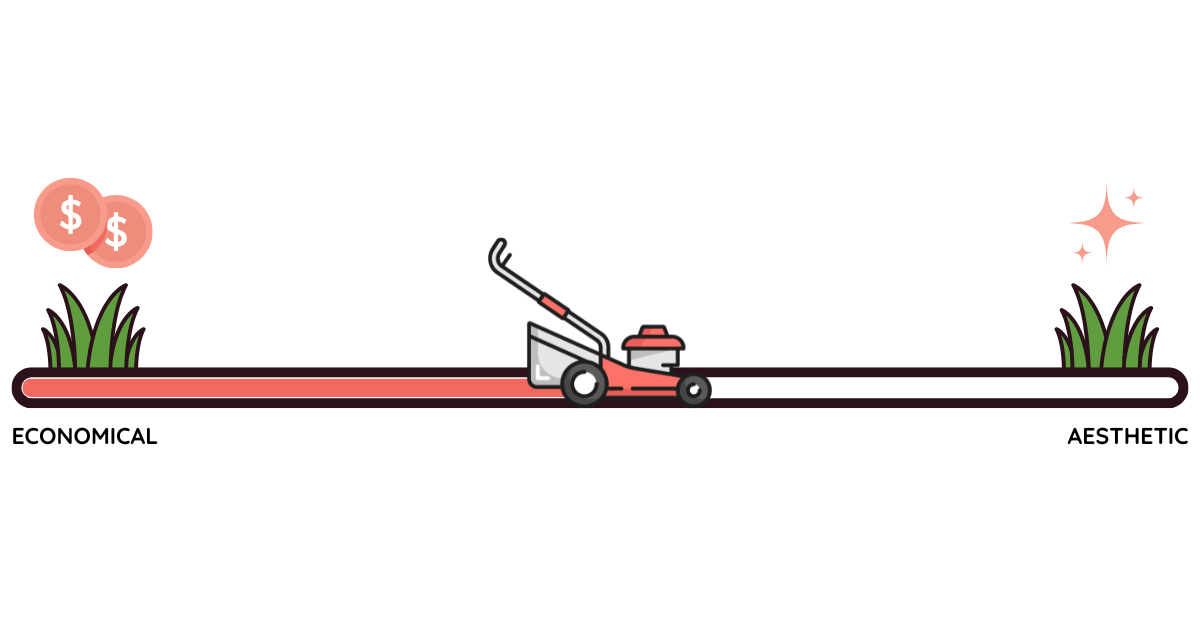
On one end would be the most economical approach: getting the job done efficiently with the equipment and schedule that costs the least. On the other end, the most aesthetic approach: using premium equipment and frequencies that create the absolute best appearance.
For most properties, it’s a mix. Where your property falls on that spectrum depends on what you tell us about your goals and budget.
For example: A school may have areas that need to be thoughtfully-manicured around offices and classrooms in order to create the most welcoming environment. However, the vast grassy playground area doesn’t need that kind of attention. The areas that need more attention would land more closely to the aesthetic end while the playground would be closer to the economical side.
When we meet with you, we listen carefully to your priorities:
- Are you optimizing for curb appeal and property presence?
- Are you balancing appearance with cost control?
- Are you prioritizing budget efficiency within acceptable appearance standards?
Once we understand where you fall on that spectrum, we can recommend mowing services, equipment, and schedules.
Five Types of Mowing Services
Not all grass is the same, and not all mowing needs are the same. We’ll recommend services that align with your goals and the type of grass on your property.
Warm Season Turf Maintenance
For warm season grasses (typically dormant in winter, actively growing spring through fall), this is your primary mowing service. We manage these from March through October, maintaining your lawn during peak growing season. Warm Season Turf Maintenance is bi-weekly in April and October, and weekly during the active growing season (May-September).
Cool Season Turf Maintenance
Cool season grasses grow year-round in our climate, but with two distinct seasons. We extend the mowing calendar into November and resume in late February, catching the growth cycles that dormant warm season grasses miss. If you have cool season turf, you’ll need additional mowing services outside the standard March-October window.
Bi-Weekly Turf Maintenance
An alternative schedule for warm season grasses where clients need every-other-week visits instead of more frequent service. This option works well for properties where appearance standards are moderate and budget is a consideration.
Lawn Scalping
A specialized service performed in late winter, scalping cuts the grass as short as possible, removing all the brown, dead grass left over from winter. For properties where quick green-up matters (like schools or corporate campuses), this service removes that dormant layer so your lawn looks vital as soon as conditions warm. It’s not necessary for every property, especially those with tight budgets.
Brush Hogging
For larger undeveloped areas like rough terrain, pastures, or properties with significant overgrowth, we deploy tractor-mounted wide-area mowers. This rough cutting manages vegetation and maintains sight lines.
Equipment Selection: Matching the Mower to the Property
The wrong mower on the wrong property can leave marks in the turf, blow clippings into flower beds, deliver a poor cut on slopes, or waste time on jobs that could be done more efficiently. At Willis, we maintain several types and sizes, and are intentional about which mower we put on your property:
Push Mower (21″ & 30″)
Used for small, confined spaces where larger equipment can’t fit or would be inefficient. Parking lot islands, small courtyards, and landscaped beds with tight access. Grass is typically bagged rather than mulched.
Sit-Down Zero Turn (52″, 60″, 72″)
The workhorse for larger open areas with relatively smooth, even terrain. These machines are faster and more economical than push mowing for big jobs, and the operator sits centrally, which gives us a longer operating life and lower fuel costs. Best suited for properties where appearance is secondary to efficiency, or where the property’s layout is open enough that cut quality doesn’t suffer from the mower’s sitting position.
Stand-On Zero Turn (52″, 60″, 72″)
The most versatile option we deploy. The operator stands on a platform, which gives two advantages. First, visibility: standing high means your crew can see exactly what’s in front of the mower deck, making these machines ideal for properties with tight corners, curbed islands, or complex layouts where precision is critical. Second, speed: they’re faster than sit-down mowers, making them economical for large properties while still delivering better cut quality in complex spaces. This is the equipment we deploy for most often.
Grass Handling Unit (48″)
A specialized machine, similar to our stand-on zero turn, that’s excellent on uneven or hilly terrain where a traditional mower deck would dig in. More importantly, it has a built-in vacuum system that pulls the cut grass up as we mow, which means no clippings are blown into beds or rough cuts. The cut quality is exceptional. The tradeoff: this is our most expensive option, reserved for properties where appearance is top priority, such as corporate campuses, private schools, and high-visibility sites.
Brush Hog (5–15′ width)
A tractor with a wide-area mower attachment, designed for rough cutting and high-speed coverage on large undeveloped properties. It’s built for volume and rugged terrain.
What to Expect from Your Mowing Team
Knowing the equipment and schedule is one thing. Knowing what actually happens when our crew shows up is another. We operate with specific protocols that reflect our commitment to doing this work well. When you work with Willis, you can expect:
Attention in Execution
✓ We don’t mow over trash. If we see something in the lawn that shouldn’t be there—a small piece of debris, a wrapper—we pick it up instead of running it over. Every once in a while, something gets past us. When that happens, we stop the mower, get off, pick up the pieces, and keep going. Trash doesn’t belong on your property, especially when it’s been cut up by a mower. We’ll handle it.
✓ We mow carefully in rocky areas. If your property has gravel or rocky terrain, throwing rocks into the street or parking lot creates hazards. We mow in directions that throw debris into the grass instead, where it won’t cause damage.
✓ We stop mowing when pedestrians are near. On active commercial properties, we pause work if people are walking close to where we’re operating. It’s a safety practice and a sign of awareness about the space we’re sharing.
✓ We time our work around your business. If you have a drive-through or loading areas, we coordinate our schedule to mow when those spaces aren’t in active use out of respect for your operation.
Equipment Maintenance Standards
✓ Blades are sharpened daily. Dull blades tear grass instead of cutting it, which leads to brown-tipped turf and disease susceptibility. We sharpen blades every day of operation to ensure every cut is clean.
✓ Oil changes and tire maintenance happen on schedule. Regular maintenance keeps equipment running at peak performance and extends its life.
✓ Mower decks are kept level. A slightly tilted deck doesn’t cut evenly. We check the deck level regularly to deliver consistent cut quality across your entire property.
It Matters Who You Hire
If you’re reading this much detail about how a landscaping company cares for turf, you probably care about more than just “getting the job done.” You care about how it’s done and why those choices were made.
We do, too. It’s why every decision we make comes from your goals. We’re not following a generic checklist. We’re thinking about your specific property and what it takes to deliver on it week after week.
Ready to Discuss Your Mowing Program?
If you want a company that can articulate why they’re making decisions about your property, let’s talk.
Request a quote, and we’ll walk you through how we’d approach your specific property. We’ll listen to your priorities, show you where we think you fall on our economic-to-aesthetic spectrum, and give you the details to make an informed decision about your landscaping.
Have questions about a specific aspect of our mowing program? We’re happy to go deeper on equipment options, seasonal considerations, or any other part of our process. Reach out. That’s exactly the kind of conversation we enjoy.
Request a Quote